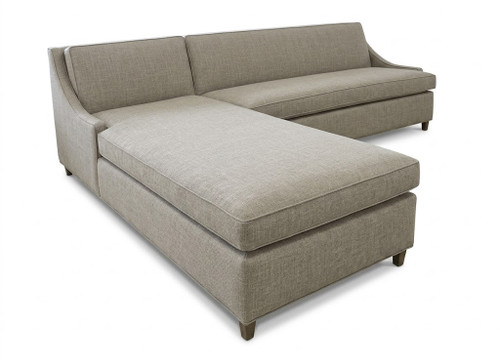
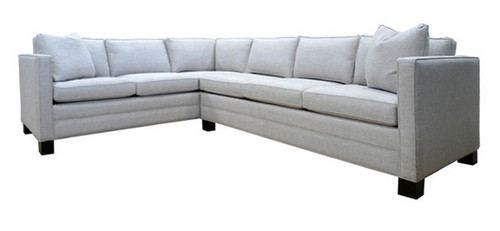
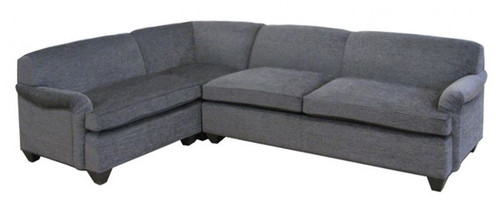
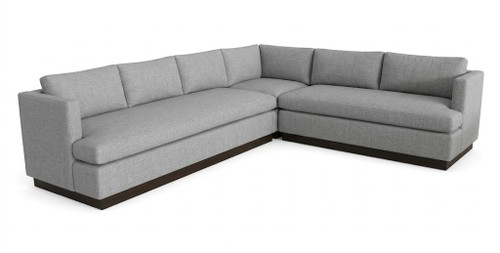
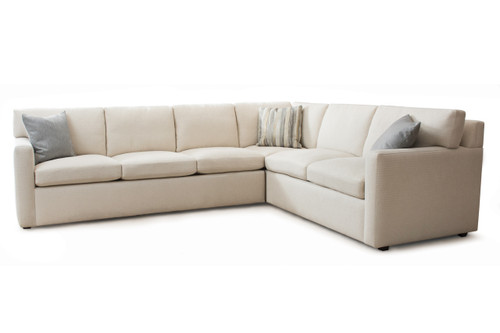
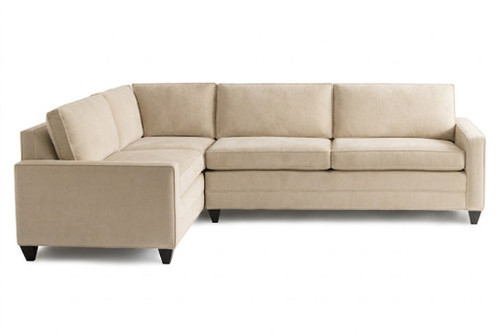
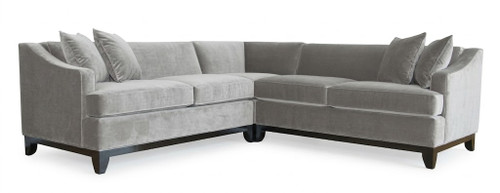
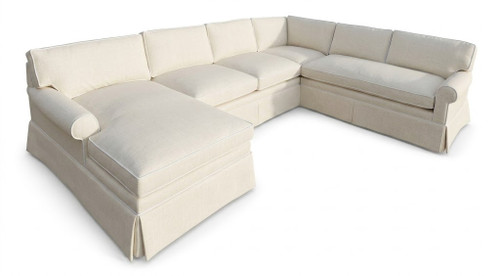
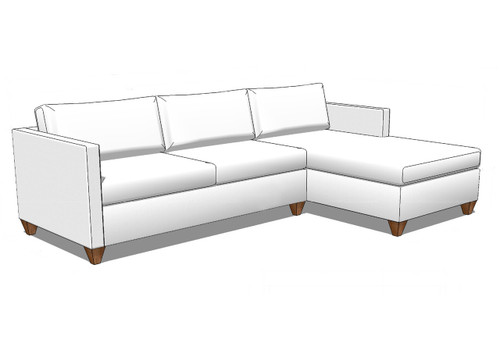
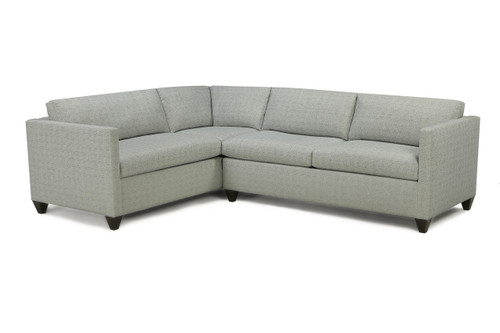
A sectional is nothing more than a combination of modules or sections that when put together achieve a desired shape or configuration. Popular shapes include: L-shaped, U-Shaped, Circular and Wedge framed sectionals. Almost every shape is possible including, S and T shapes, Octagonal, and of course, Long-Wall installations. Every frame component can be of standard or custom size as well as styled to specification.


We always describe a sectional as though we are standing directly in front of it, face to face, regardless of where it is placed within the room.


A sectional begins with at least two pieces or sections. These sections can be finished with any arm style or without arms, depending on taste and need. Furthermore, every component must be either completely armless, semi-armless or possess a “return arm”, in order for them to join properly. Wherever joined, the “pitch” of the inside back should be uniform and fluid on both pieces (see fig. A, B, E, F).
Armless Pieces: (see fig. A, B, C). The piece is void of arms and can therefore be joined together at either end by another armless, semi-armless, return arm or corner piece. The total length of the cushions on an armless piece is equal to its over all length. For example (see fig. D), an 80" armless piece can be made with a single 80" cushion or 2-40" cushions or 3-26.6" cushions.
Semi-Armless Pieces: (see fig. E) These are pieces that have a finished arm on one end and are armless on the other. They can only be joined where they are armless, by another armless piece, semi-armless, return arm or corner piece. A semi-armless piece is described as either a “Left arm Facing, right side armless” or a “right arm Facing, left side armless” (see fig. G). The length of the seat cushions equals the overall length minus the width of the finished arm.
“Return Back” (see fig. D1) If not joined together to form a straight line (see fig. A1), then one of the two pieces must possess a “return back” in order for the two pieces to fit together properly (see fig. B1, C1, D1). A return back is simply an extension of the “inside back” of the sectional where the two pieces meet. Any frame can be made with a return back but care must be taken to differentiate between the overall outside length of the piece and the inside seating area.
The reason: the return back takes up 14" of the total length of a sectional finished with a Tight back (see fig. D1), or 10'' to 11'' on a sectional finished with loose back cushions. For example (see fig. E1), assume the overall length of a Tight back piece with a return back is 80", the return back itself is 14", and the opposite arm is 5", therefore, the total seating area is 61" (80-14-5=61"). This will yield 1-61" seat or 2- 30.5" seats.
By contrast, if one mistakenly assumed the “return back” on the same 80" piece is only 5", the same as the opposite arm, one would erroneously expect to receive that piece with an inside seat of 70", thus 1 70" seat or 2 35" seats (80"-5"-5"=70"). A return back is 14" on a tight back sectional (10'' to 11'' on loose pillow backs) and must be factored into the overall length as well as the overall seat dimensions. This is very important to bare in mind when specifying any “return back” sectional where the client assumes or expects all the seat cushions to be the same size. A very common assumption and demand but many times overlooked until it is too late. Plan ahead, don’t forget the “return back” is 10'' to 14" depending on the style. A return back is especially useful when space is limited demanding a need to keep the number of upholstered pieces in the room to a minimum. In most cases a return back performs the same function as a separate “corner piece”, only using one less piece (see fig C1).

Corner Pieces: A corner piece simply provides an angled link between two armless or semi-armless pieces (see fig. xx ). The same corner piece can be used in either a “right” or “left” position, although it is always important to specify its end use, in order to solidify the position of the other pieces thus eliminating any possible confusion. Corner Pieces are available as a Simple Corner, Wedge Corner, and Rounded Corner pieces (see fig. xx).
Always remember to specify its position as right or left. The overall dimensions of any given corner piece will vary depending upon the frame style chosen as well as any specified custom changes in seat depth and back height.
Chaise: Very versatile and stylish, a chaise can be used to cap any armless or semi-armless piece. Designed for lounging, they can be custom ordered to any width, height and length. A chaise can be finished armless or with any arm style and custom detail, including a rounded front (see fig. xx). Chaises with arms are specified as a “right arm facing” and/or a “left arm facing” chaise.
The Sleeper Section: Within most sectional configurations, large or small, a STEELWEAVE™ mechanism can be hidden in any armless or semi-armless component (see fig. xx). Chaises, corner pieces and pieces with return arms generally do not allow themselves to house a sleeper of any kind because of their inherent size and function. In the case of a piece with a return arm there is simply no room to open the bed unless the semi-armless piece is moved out of the way, thus rendering it a fairly impractical application (see fig. xx).
Any time a bed is opened, whether in a sectional or not, it is necessary to have at least 90" of clearance from the very back of the finished frame into the room (see fig. xx).
Depending on their size and need, many sectionals can be fitted with two or more beds (see fig. xx). Long- Wall sectionals may contain and may have open any combination of two or more size beds at the same time. All other sectionals can contain two or more beds but they can not be opened at the same time unless the sectional is divided. Even so, the advantage of having two beds, especially of different sizes, is that a host can then decide which bed to open depending on the needs of their guest.
Remember, the mechanism and mattress make up part of the seating, therefore the section containing them will have a slightly different feel than the rest of the sectional where the seating cavity is made up of springs. Very often our sectionals are specified with multiple beds simply to provide more uniform as well as a longer lasting seating cavity. A folded mattress and mechanism is much heavier, stronger and a bit firmer than any traditional spring cavity, thus there are pros and cons to consider when specifying any sectional with or without a bed.

When ordering any sectional, ideally a number of precautions should be taken. First, a detailed memorandum of the desired end product should be requested. In order to receive an accurate quote Carlyle needs to know: 1. The style number; 2. The # of pieces and orientation; 3. A detailed description of each component, including size, tailoring details, cushion fill, bed size, and orientation; 4. A detailed description or sample of the C.O.M. to be applied.
1. The style # : Unless otherwise specified the style # determines the back height, arm height, and seat depth. Figures A, B, C are examples of sectional styles Armless, 7770, and 4440 respectively. Please refer to their respective specifications page to review sizes and dimensions. If there are to be any changes to the standard dimensions, clearly indicate such.
2. The # of pieces and orientation: Figures A, D and D1 are examples of 2 piece sectionals. Figures A1 and D2 are three piece sectionals. Hidden behind the center toss pillows of figure B is a “left corner” piece. Figure A, for example, would be described as a 2-piece armless sectional – one armless piece and one left side “return back”/right side armless piece. Figures B and C do not require “return backs” because they employ the proper use of semi-armless, corner or chaise pieces. Figure B (pg. 27) is a three piece sectional comprised of one separate corner piece and 2 semi-armless pieces. The section with two seats is a “left facing arm” and the section with three seats is a “right facing arm”. Figure C shows a simple 2-piece sectional with a chaise. One semi-armless piece, left side facing/right side armless, and one semi-armless chaise, right-arm-facing/left side armless. Including a detailed floor plan or in the least a rough drawing of the orientation of pieces can be extremely useful.

3. A detailed description of each component, including; size, tailoring details, cushion fill, bed size, and orientation.
For example, Figure B would be specified as follows:
Sectional Style 7770, 3 pieces. 100" x 125", no special changes with queen bed in 3 seat section.
1- 40" x 40" Corner Piece. Welted.
- with - 1 25/75 spring and down seat cushion
- 5”Box welt
- 2 50/50 down and feather return backs
- Bull nose
1 - 60" Left Arm Facing - No bed.
Arm with welted/shirred fitted panel and welted tack panel.
- with - 2 25/75 spring and down seat cushion - 5" Box welt
-2 50/50 d & f backs - Bull nose
1 - 85" Right Arm Facing - Queen bed/Deluxe. Arm with welted/shirred fitted panel with welted tack panel - with - 3 25/75 spring and down seat cushion
- 5"Box welt
-3 50/50 d & f backs - Bull nose
6 - 22" x 22" 25/75 D & F throws knife welt/ turkish corners
2 - 8" diameter bolsters. 25/75 D & F. Center button/shirred panels.
*The sectional must have a base fringe applied. Please advise on yardage. Under the fringe the client would prefer large walnut stained wedge legs as opposed to a recessed base.
Be as detailed and as redundant as possible, and necessary. We feel more information is always better than less, thus providing us everything needed to eliminate any guesswork.
4. A detailed description or sample of the C.O.M. to be applied. In the absence of a full cut sample, please provide the width of the fabric as well as the vertical and horizontal repeat of any pattern if there is any. Providing information on the type of fabric, it’s content and applied direction can also help us to assist in avoiding many costly mistakes, like ordering too much or too little fabric, not having the proper backing or simply to address any unforeseen issues regarding application, matching, etc.

At Carlyle Sofas, we like to measure three times, but only specify and cut fabric once.
Once the memorandum has been approved by all parties, a detailed purchase order should follow. The purchase order should include all information contained in the memorandum. In the absence of a full cut sample, please provide the width of the fabric as well as the vertical and horizontal repeat of any pattern if there is any. Remember, providing information on the type of fabric, its content and applied direction can also help us to assist in avoiding many costly mistakes, like ordering too much or too little fabric, not having the proper backing or simply to address any unforeseen issues regarding application, matching, etc.

Bring or send us your floor plans so we can assist in designing your ultimate
sectional. Round, square, or any combination can be achieved. We can even plan and build around
architectural jogs and support beams.